> For the complete documentation index, see [llms.txt](https://doc.realvirtual.io/llms.txt). Markdown versions of documentation pages are available by appending `.md` to page URLs; this page is available as [Markdown](https://doc.realvirtual.io/basics/user-interface/model-checker.md).
# Model Checker
Finding common issues in your model
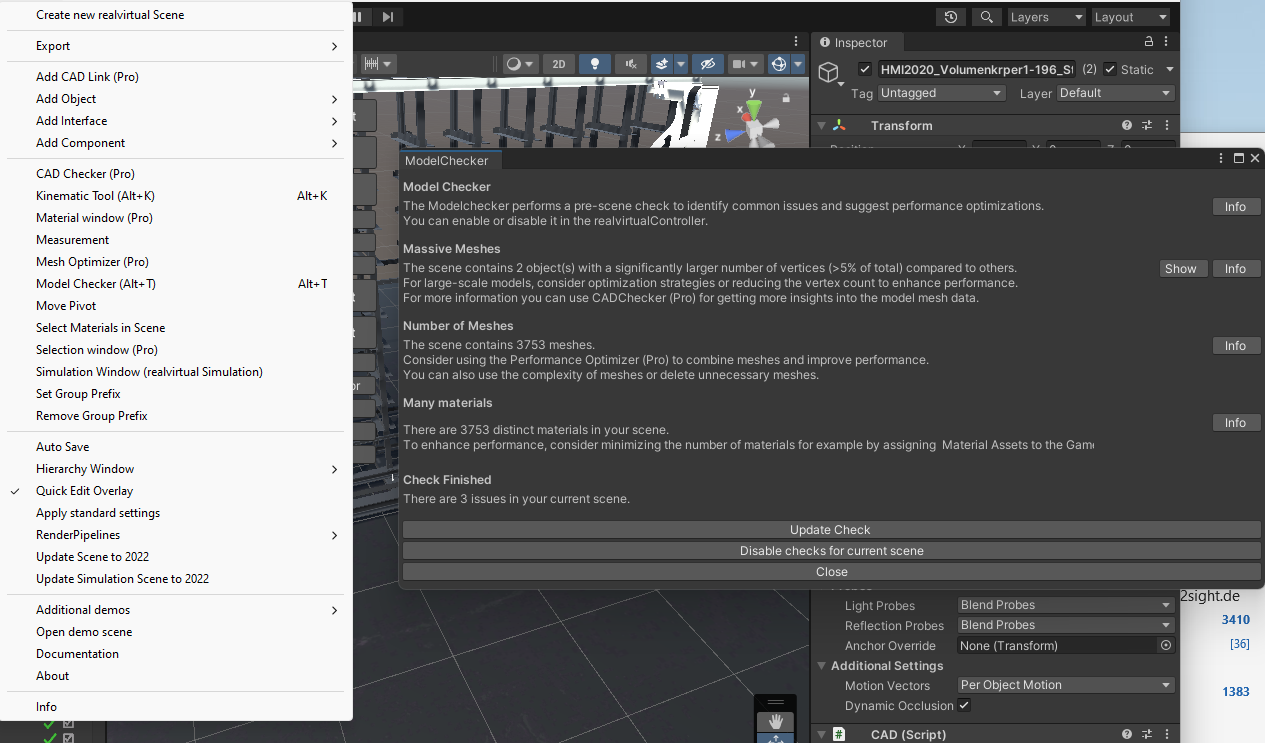
In new scenes, the Model Checker runs automatically upon scene startup to detect common issues and recommend performance optimizations. You can activate the checker using the shortcut Alt+T or via the main menu. To deactivate it, use the provided buttons in the UI. Select the "Info" button to view relevant documentation pages, or choose "Show" for certain issues to highlight related game objects in the scene.
Model Checker for detecting common issues in the current scene.
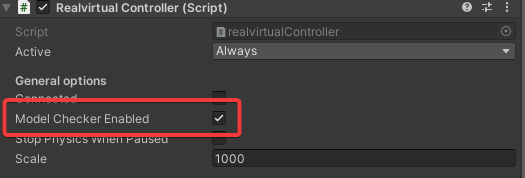
Alternatively, the Model Checker can be disabled through the setting in the scene's realvirtualController.
Turning off model checker in realvirtualController
Here is an overview of the performed checks:
1. **CheckNonStaticMeshes:** Identifies non-moving GameObjects without Drive components in parent hierarchies.
2. **CheckStaticMeshes:** Detects static meshes under drives that prevent movement.
3. **HugeMeshes:** Warns about objects with excessively large vertex counts (>5% of total) compared to others.
4. **NumberOfMeshes:** Advises on optimizing performance by reducing the number of meshes if exceeding 1000.
5. **NonSharedMaterials:** Alerts about GameObjects with a high number of distinct materials (>20) for optimization.
6. **MUsWithoutRigidbody:** Highlights MUs lacking Rigidbody components for physics interactions.
7. **GuidedTransport:** Identifies MUs without GuidedMU components needed for guided transport surfaces.
8. **SensorRaycastLayer:** Advises adding standard layers (rvMU or rvMUSensor) for Raycast Sensors to detect collisions with MUs.
9. **CheckSinkLayer:** Advises using the standard layer (rvSensor) for Sink components for collision detection with MUs.
10. **SensorColliderLayer:** Suggests using the standard layer (rvSensor) for Collider Sensors for efficient collision detection with MUs.
11. **ComplexColliders:** Notes the presence of numerous Mesh Colliders (>20) and suggests using simpler colliders like Box Colliders for better performance.
12. **ManyColliders:** Alerts about a high number of colliders (>300) in the scene, advising reduction for performance improvement.
13. **CollidersOnNonStandardLayers:** Identifies Colliders not on standard layers (rvMU, rvMUSensor, rvTransport, rvSelection, rvSensor), recommending standard layers for efficient collision detection.
14. **NumberOfLights:** Advises optimizing performance by reducing the number of lights (>2) and turning off shadows.
These checks aim to improve scene performance and functionality by identifying common issues and providing actionable recommendations.
---
# Agent Instructions
This documentation is published with GitBook. GitBook is the documentation platform designed so that both humans and AI agents can read, navigate, and reason over technical content effectively. Learn more at gitbook.com.
## Querying This Documentation
If you need additional information that is not directly available in this page, you can query the documentation by asking a question.
Perform an HTTP GET request on the following URL with the `ask` and `goal` query parameters:
```
GET https://doc.realvirtual.io/basics/user-interface/model-checker.md?ask=&goal=
```
`ask` is the immediate question: it should be specific, self-contained, and written in natural language.
`goal` is what the user is ultimately trying to achieve, the reason they need the answer. Sharing it helps GitBook give you a better, more relevant answer. A goal is most helpful when it describes the outcome the user wants rather than restating the question. For example, with `ask=how do I create an API token`, a goal like `automate deployments from our CI pipeline` lets GitBook tailor the answer to that use case.
The response will contain a direct answer to the question and relevant excerpts and sources from the documentation.
Use this mechanism when the answer is not explicitly present in the current page, you need clarification or additional context, or you want to retrieve related documentation sections.