> For the complete documentation index, see [llms.txt](https://doc.realvirtual.io/llms.txt). Markdown versions of documentation pages are available by appending `.md` to page URLs; this page is available as [Markdown](https://doc.realvirtual.io/basics/folder-structure.md).
# Folder structure
Package and folder structure of realvirtual
{% hint style="info" %}
Starting with version **6.3**, realvirtual is distributed as **UPM (Unity Package Manager) packages**. The folder structure changed significantly from the previous `Assets/realvirtual/` layout used in 6.0 and earlier.
{% endhint %}
## Package Overview
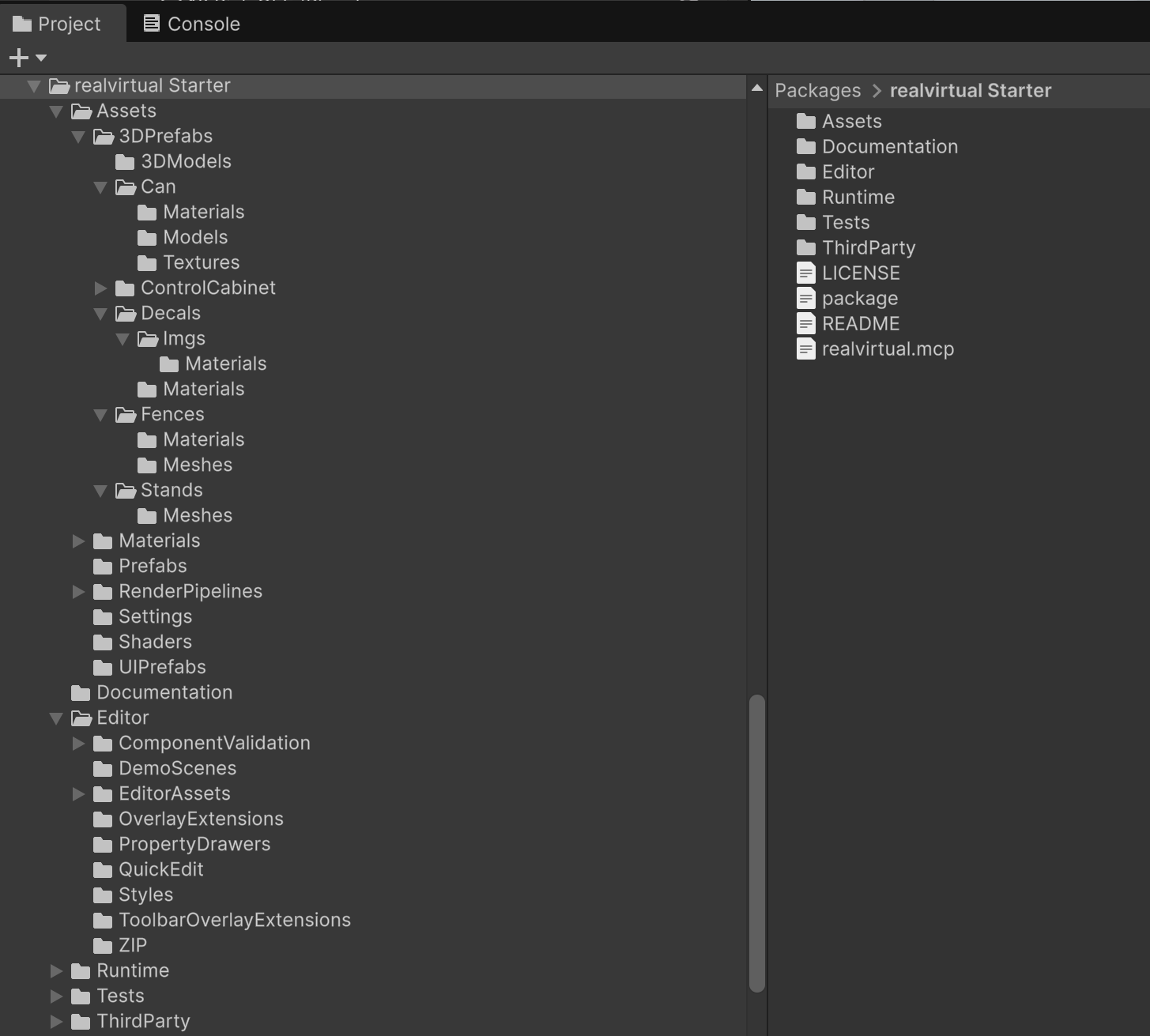
realvirtual UPM package structure
realvirtual is split into two UPM packages:
| Package | Location | Description |
| ------------------------------- | --------------------------------------- | --------------------------------------------------------------------- |
| **io.realvirtual.starter** | `Packages/io.realvirtual.starter/` | Core framework — drives, sensors, signals, transport, gripping, logic |
| **io.realvirtual.professional** | `Packages/io.realvirtual.professional/` | Professional add-on — IK, CADLink, interfaces, multiplayer, and more |
{% hint style="warning" %}
UPM packages are **read-only** in Unity. You cannot edit files inside `Packages/`. Place your own scenes, scripts, and assets in the `Assets/` folder.
{% endhint %}
## Starter Package Layout
The Starter package (`Packages/io.realvirtual.starter/`) contains:
| Folder | Description |
| ----------------------- | ---------------------------------------------------------------------------------------------------------------- |
| **Assets/** | User-facing assets you drag into scenes |
| Assets/3DPrefabs/ | Industrial 3D models (conveyors, robots, boxes, fences) |
| Assets/Materials/ | Industrial materials (plastics, metals, lamp indicators) |
| Assets/Prefabs/ | Core functional prefabs (realvirtual.prefab, signal prefabs, interfaces) |
| Assets/UIPrefabs/ | Runtime UI overlay prefabs |
| Assets/Settings/ | Editor gizmo options, camera presets |
| Assets/RenderPipelines/ | URP pipeline configuration and settings |
| **Runtime/** | All runtime C# scripts (components, behaviors, interfaces) |
| **Editor/** | Editor tools, inspectors, and toolbar |
| **Samples\~/** | Demo scenes — import via [Demo Scenes Browser](/basics/user-interface/demo-scenes-browser.md) or Package Manager |
## Professional Package Layout
The Professional package (`Packages/io.realvirtual.professional/`) contains:
| Folder | Description |
| ------------------------ | ----------------------------------------------------------------------------------------------------- |
| **Runtime/** | Pro features organized by domain |
| Runtime/IK/ | [Robot Inverse Kinematics](/components-and-scripts/robot-inverse-kinematics.md) + robot prefabs |
| Runtime/Interfaces/ | All Pro [interfaces](/components-and-scripts/interfaces.md) (OPC-UA, TwinCAT, KUKA, UR, Modbus, etc.) |
| Runtime/CADLink/ | [CAD file import](/basics/cad-import.md) |
| Runtime/PathTracer/ | Motion trail visualization |
| Runtime/Statistics/ | Simulation statistics |
| Runtime/Multiplayer/ | Multi-user networking |
| Runtime/HighlightSystem/ | Object highlighting and selection |
| Runtime/DistanceSystem/ | Distance measurement and connectable objects |
| **Editor/** | Pro editor tools |
| **Samples\~/** | Pro demo scenes (PLC Interfaces, Robotics, Robot Interfaces, Advanced Features) |
## Key Asset Locations
When setting up scenes, you will frequently need these assets:
| What you need | Where to find it |
| ----------------------- | ------------------------------------------------------------------------------------------------------------------------- |
| Main framework prefab | `Packages/io.realvirtual.starter/Assets/Prefabs/realvirtual.prefab` |
| Industrial 3D prefabs | `Packages/io.realvirtual.starter/Assets/3DPrefabs/` |
| Materials library | `Packages/io.realvirtual.starter/Assets/Materials/` |
| PLC signal prefabs | `Packages/io.realvirtual.starter/Assets/Prefabs/` |
| Interface prefabs (Pro) | `Packages/io.realvirtual.professional/Runtime/Interfaces//` |
| Robot prefabs (Pro) | `Packages/io.realvirtual.professional/Runtime/IK/` |
| Demo scenes | Import via [Demo Scenes Browser](/basics/user-interface/demo-scenes-browser.md) or **Window > Package Manager > Samples** |
## Your Project Content
Place all your project files in `Assets/`:
* **Scenes** — your simulation scenes
* **Scripts** — custom C# scripts and behaviors
* **Prefabs** — your own reusable prefabs
* **Materials** — custom materials
* **Imported CAD data** — files imported via CADLink
## Previous Folder Structure (6.0 and earlier)
{% hint style="info" %}
In versions before 6.3, realvirtual was distributed as a `.unitypackage` installed into `Assets/realvirtual/`. This folder no longer exists in UPM-based installations. See the [Upgrade Guide](/advanced-topics/upgrade-guide.md) for migration instructions.
{% endhint %}
---
# Agent Instructions
This documentation is published with GitBook. GitBook is the documentation platform designed so that both humans and AI agents can read, navigate, and reason over technical content effectively. Learn more at gitbook.com.
## Querying This Documentation
If you need additional information that is not directly available in this page, you can query the documentation by asking a question.
Perform an HTTP GET request on the following URL with the `ask` and `goal` query parameters:
```
GET https://doc.realvirtual.io/basics/folder-structure.md?ask=&goal=
```
`ask` is the immediate question: it should be specific, self-contained, and written in natural language.
`goal` is what the user is ultimately trying to achieve, the reason they need the answer. Sharing it helps GitBook give you a better, more relevant answer. A goal is most helpful when it describes the outcome the user wants rather than restating the question. For example, with `ask=how do I create an API token`, a goal like `automate deployments from our CI pipeline` lets GitBook tailor the answer to that use case.
The response will contain a direct answer to the question and relevant excerpts and sources from the documentation.
Use this mechanism when the answer is not explicitly present in the current page, you need clarification or additional context, or you want to retrieve related documentation sections.