> For the complete documentation index, see [llms.txt](https://doc.realvirtual.io/llms.txt). Markdown versions of documentation pages are available by appending `.md` to page URLs; this page is available as [Markdown](https://doc.realvirtual.io/extensions/modelzoo.md).
# ModelZoo
Free prepared demonstration and demo szenes
The **realvirtual.io ModelZoo** is a curated collection of ready-to-use simulation models for training, testing, and demonstration. Each model is built to highlight specific capabilities of the realvirtual.io platform — from fully simulated demo scenes to advanced virtual commissioning setups with real PLC and robot controller integration.
{% embed url="" %}
Modelzoo Download
{% endembed %}
All models are delivered as standalone `.exe` applications and can be used **without a license**.
Whether you're learning PLC programming, testing robot communication, or evaluating automation workflows, the ModelZoo provides a fast, hands-on way to explore realvirtual.io in action.
> ℹ️ **Note:** For models requiring PLC or robot controller integration, please refer to the individual documentation pages for setup instructions and prerequisites.\
> Pure simulation scenes that do not require special hardware or connections are **not documented** here.
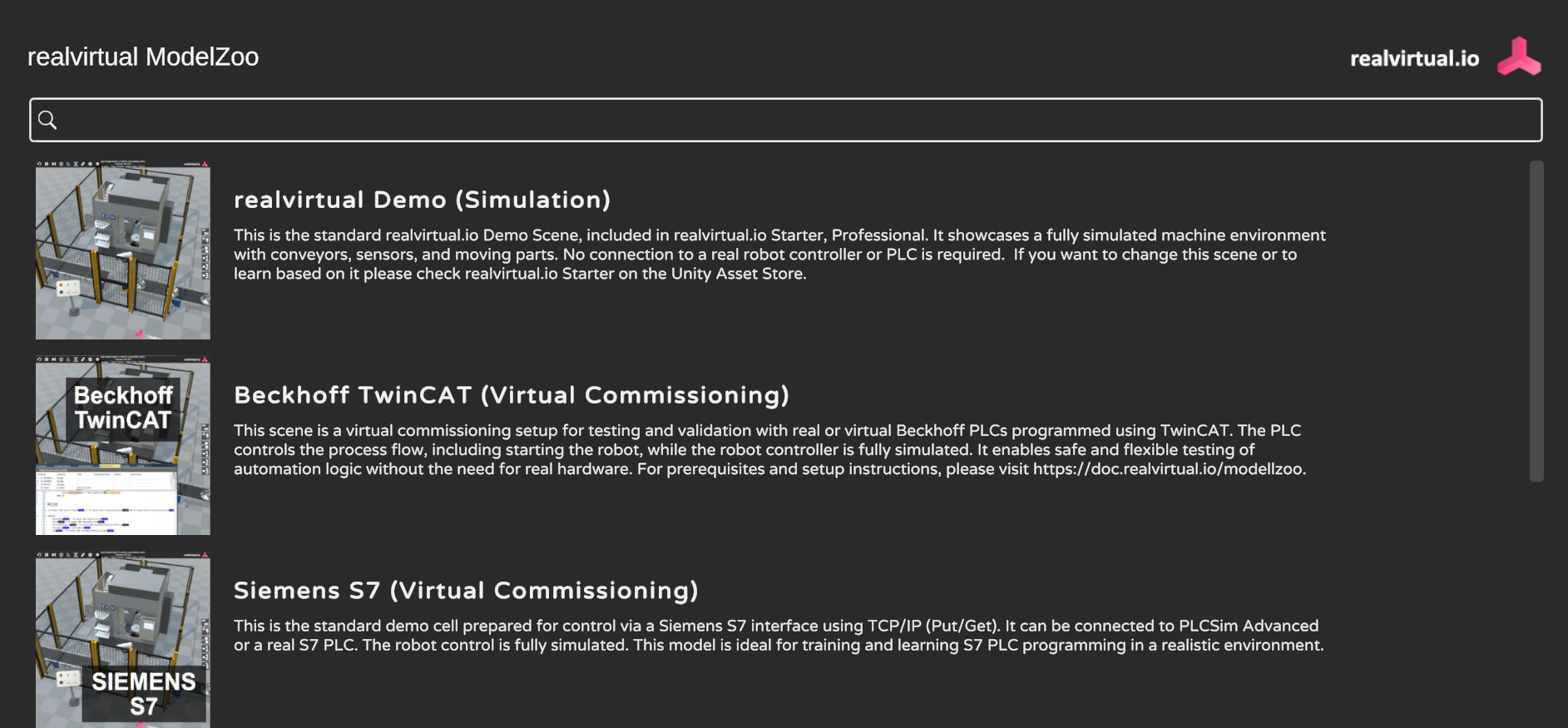
Modelzoo scene selection
## Basic Controls
The following controls apply to all **ModelZoo** scenes:
* **Rotate / Zoom / Pan** using the **middle and right mouse buttons**
* Press **ESC** to close the current scene and return to the **scene selection menu**
* Press **F** to **focus the camera** on the current scene if you're lost in 3D space
For more UI features and shortcuts, check out the [Runtime UI Documentation](/basics/runtime-ui.md).
## Virtual Commissioning Interface Setup
For all **virtual commissioning** models, the communication interface (such as IP address, port, or NetID) must be configured before connecting.
To do this:
* Click the **⚙️ Settings** icon in the **top menu bar**
* Enter the required connection parameters for your target system
* All models start in **"Non Connected"** mode by default
* After entering the parameters, click the **🔌 Connect switch** (represented by two plugs)
If the switch turns **green**, the connection is successfully established.
> Note: In some interfaces, the connection status may fluctuate briefly, and the simulation may experience short lags during connection or reconnection.\
> \
> After setting the interface properties once they are saved and on the next scene start they will be the same.
For detailed setup instructions, refer to the individual model documentation.
## Log Window
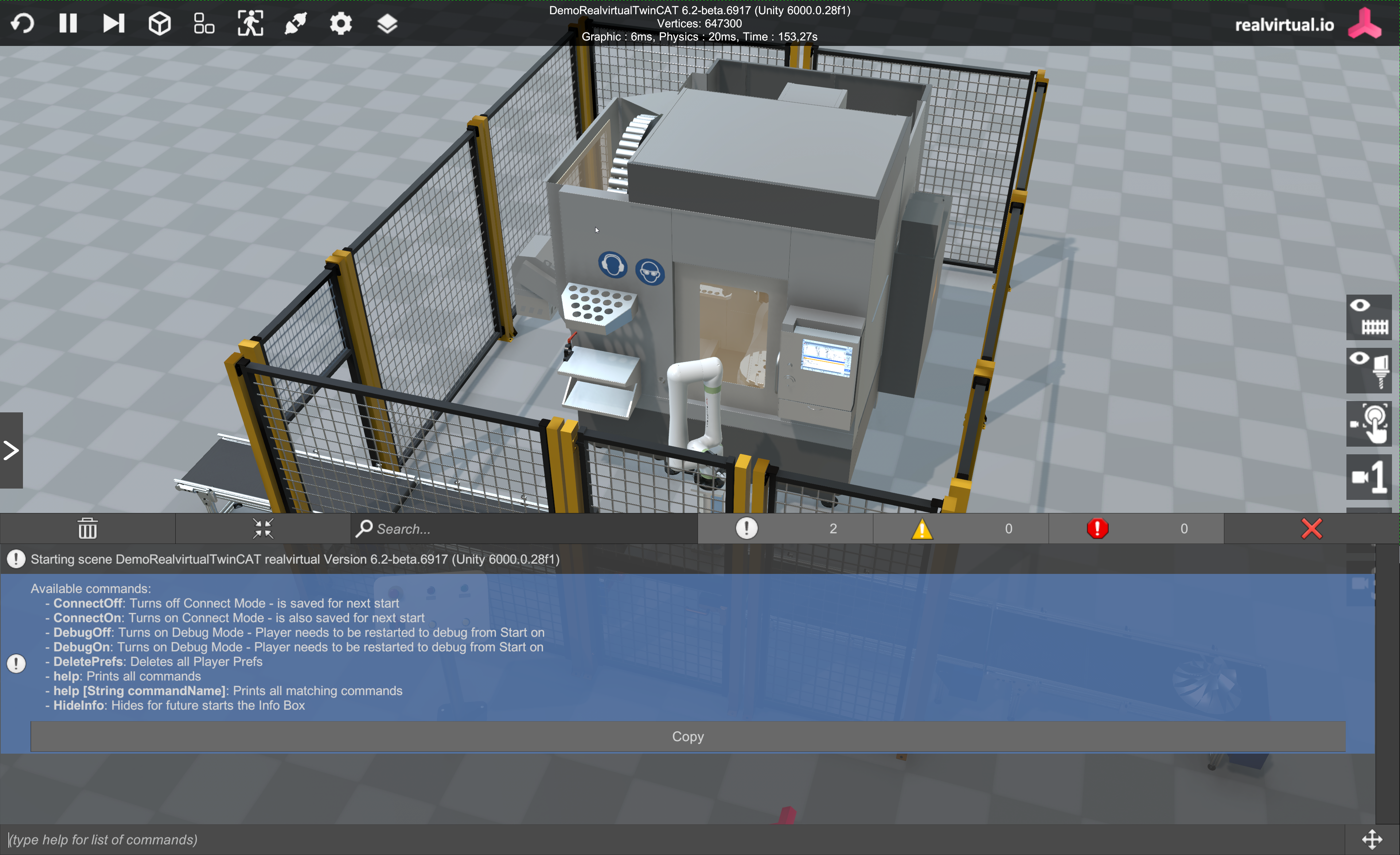
Most scenes in the **ModelZoo** include a built-in **Log Window** at the bottom of the screen.
Log Window
You can open it by clicking the small **icons in the lower-left corner** of the screen.
The log window allows you to:
* View messages about the **current version** and **scene status**
* Monitor **connection feedback** and warnings
* Enter **special commands** to control simulation behavior
Type `help` in the input field to see a full list of available commands.
One especially useful command is:
* `HideInfo` – Hides the info box that appears at the start of the scene
This tool is particularly valuable for setup verification, debugging, and customizing your simulation experience.
---
# Agent Instructions
This documentation is published with GitBook. GitBook is the documentation platform designed so that both humans and AI agents can read, navigate, and reason over technical content effectively. Learn more at gitbook.com.
## Querying This Documentation
If you need additional information that is not directly available in this page, you can query the documentation by asking a question.
Perform an HTTP GET request on the following URL with the `ask` and `goal` query parameters:
```
GET https://doc.realvirtual.io/extensions/modelzoo.md?ask=&goal=
```
`ask` is the immediate question: it should be specific, self-contained, and written in natural language.
`goal` is what the user is ultimately trying to achieve, the reason they need the answer. Sharing it helps GitBook give you a better, more relevant answer. A goal is most helpful when it describes the outcome the user wants rather than restating the question. For example, with `ask=how do I create an API token`, a goal like `automate deployments from our CI pipeline` lets GitBook tailor the answer to that use case.
The response will contain a direct answer to the question and relevant excerpts and sources from the documentation.
Use this mechanism when the answer is not explicitly present in the current page, you need clarification or additional context, or you want to retrieve related documentation sections.