> For the complete documentation index, see [llms.txt](https://doc.realvirtual.io/llms.txt). Markdown versions of documentation pages are available by appending `.md` to page URLs; this page is available as [Markdown](https://doc.realvirtual.io/basics/runtime-ui/mouse-sensitivity.md).
# Mouse Sensitivity
Control 3D navigation sensitivity during runtime with persistent settings.
{% hint style="info" %}
**New in Version 6.0.3**: Mouse Sensitivity control is available in the Settings window during Play Mode.
{% endhint %}
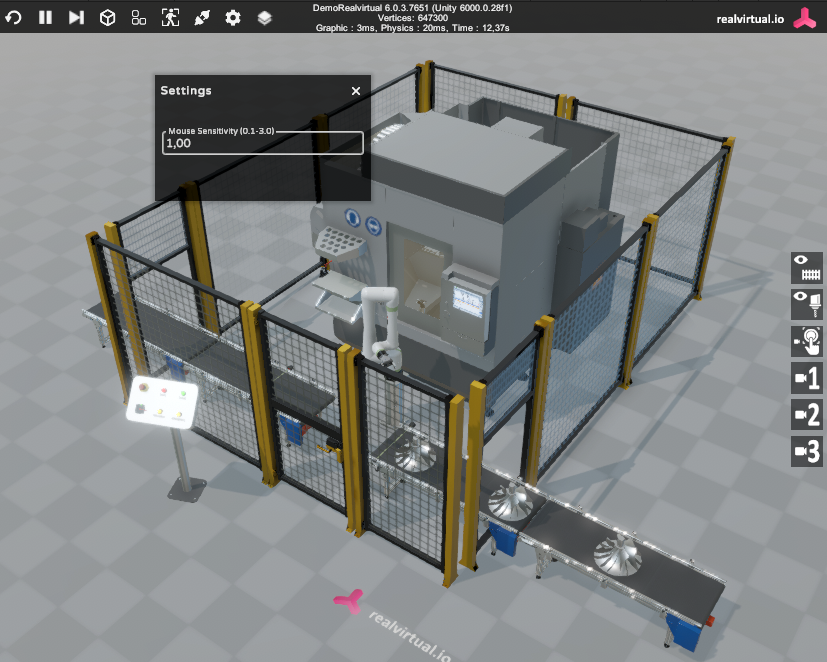
Settings window showing Mouse Sensitivity slider (0.1-3.0 range) during Play Mode
## Overview
The Mouse Sensitivity feature allows users to adjust 3D navigation speed in real-time during Play Mode. Settings are automatically saved and restored across Unity sessions.
## Settings
* **Range**: 0.1 (very slow) to 3.0 (very fast)
* **Default**: 1.0 (normal sensitivity)
* **Access**: Settings window during Play Mode
* **Persistence**: Automatically saved using Unity PlayerPrefs
## Navigation Types Affected
* Camera rotation and orbiting
* Zoom controls (scroll wheel)
* Panning operations
* Touch navigation on mobile devices
## How to Use
1. Enter **Play Mode** in Unity
2. Open the **Settings** window from the runtime UI
3. Adjust the **Mouse Sensitivity** slider to your preference
4. Changes apply immediately
5. Settings persist automatically when exiting Play Mode
## Use Cases
* **Accessibility**: Accommodate different user preferences
* **Hardware Compatibility**: Adjust for different mouse types and DPI settings
* **Training Environments**: Provide comfortable navigation for new users
* **Demonstrations**: Quick sensitivity adjustment for different presentation scenarios
---
# Agent Instructions
This documentation is published with GitBook. GitBook is the documentation platform designed so that both humans and AI agents can read, navigate, and reason over technical content effectively. Learn more at gitbook.com.
## Querying This Documentation
If you need additional information that is not directly available in this page, you can query the documentation by asking a question.
Perform an HTTP GET request on the following URL with the `ask` and `goal` query parameters:
```
GET https://doc.realvirtual.io/basics/runtime-ui/mouse-sensitivity.md?ask=&goal=
```
`ask` is the immediate question: it should be specific, self-contained, and written in natural language.
`goal` is what the user is ultimately trying to achieve, the reason they need the answer. Sharing it helps GitBook give you a better, more relevant answer. A goal is most helpful when it describes the outcome the user wants rather than restating the question. For example, with `ask=how do I create an API token`, a goal like `automate deployments from our CI pipeline` lets GitBook tailor the answer to that use case.
The response will contain a direct answer to the question and relevant excerpts and sources from the documentation.
Use this mechanism when the answer is not explicitly present in the current page, you need clarification or additional context, or you want to retrieve related documentation sections.